
Intelligent bidding, Target CPA and Target CPC, the dates Max Bid and Max CPC retire, and how OpenAI says the winning bid sets the price you pay.
On this page
- The short version
- The bid strategies, as OpenAI describes them now
- The dates that matter
- How the auction prices a click or an impression
- Setting a realistic target
- Audience bid multipliers
- Conversion data comes first
- Bidding is not billing
- What the older help articles still say
- How your bid and your budget interact
- Which strategy fits your situation
- Reading bid warnings correctly
- Common bidding mistakes
- UAE specifics
- Quick answers
The short version
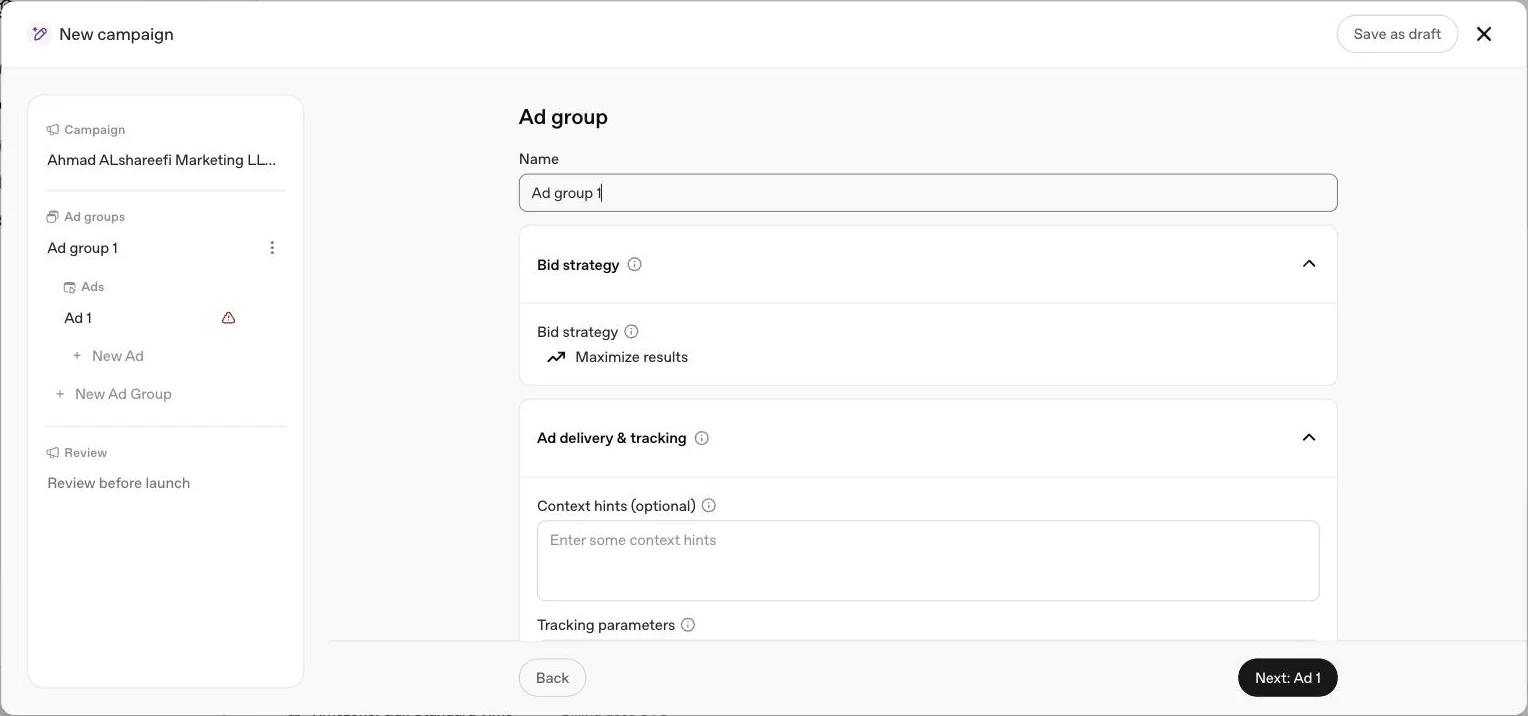
OpenAI rebuilt bidding on 9 November 2026. Its newest bidding article names three strategies: Intelligent bidding, which chases results within your budget, Target CPA for conversion campaigns and Target CPC for click campaigns. The old maximum bid controls, Max Bid and Max CPC, are legacy settings that retire on 1 January 2027. The pricing rule changed in the wording too. OpenAI no longer describes a second price auction. Its bidding article now says "The final winning auction bid sets the price you pay," and that this applies to every bidding strategy. None of the options is a price guarantee.
The bid strategies, as OpenAI describes them now
| Strategy | What you tell the system | What OpenAI says about it |
|---|---|---|
| Intelligent bidding | Your outcome and your budget | Formerly Maximize Results (Autobid). Adjusts bids and delivery to drive your outcome within budget. No individual bids to manage |
| Target CPA (conversion campaigns) | The average you would like to pay per conversion | Works toward that average while getting as many conversions as possible from the budget. Replaces Max Bid for new conversion campaigns from 9 November 2026 |
| Target CPC (click campaigns) | The average you would like to pay per click | Can bid above or below the target in single auctions while working toward the average. Available for new click campaigns from 9 November 2026 |
| Max Bid and Max CPC (legacy) | A ceiling on each bid | Legacy controls on existing campaigns. They retire on 1 January 2027 |
OpenAI's own summary of the direction: you tell it "the outcomes you care about and the budget or target cost that works for your business," and its system adjusts bids and delivery toward those goals.
The dates that matter
If you run campaigns on a maximum bid today, plan the move before the end of December rather than letting the change happen to you on 1 January.
How the auction prices a click or an impression
OpenAI's current wording is short: "Auctions determine which eligible ads are shown. The final winning auction bid sets the price you pay. This pricing rule applies across all bidding strategies, including existing Max Bid and Max CPC campaigns."
Two points follow, both in OpenAI's own words or close to them.
- The system chooses the auction bid for you under the new strategies. With Intelligent bidding, Target CPA or Target CPC, OpenAI says its system "considers the likelihood of a click or conversion alongside the price it would pay, then chooses auction bids on your behalf." Your budget and any target guide those choices.
- Relevance still shapes which ad shows. OpenAI's basics article says ads are selected on expected relevance and outcomes, using the conversation, your landing page, title, copy and context hints. Its troubleshooting guidance adds that raising your bid does not guarantee delivery. See our context hints guide and our guide to ads not showing.
Setting a realistic target
A target is a goal for the average, not a ceiling. OpenAI says Target CPA and Target CPC "are average-cost goals. Actual average costs can be higher or lower, and individual results can cost different amounts." It also warns that a target below recent performance may restrict delivery.
OpenAI's own method for picking a number:
Start from what you actually paid
Review recent actual CPA for the same conversion event, or actual CPC for a click campaign, over a consistent period, allowing for conversion reporting delay.
Compare it with what a result is worth
Weigh recent performance against what the outcome is worth to your business.
Set the target as the campaign moves, then watch it learn
Review spend, results and actual average cost together while the campaign learns on the new strategy.
OpenAI's worked example: 400 US dollars of spend and 10 attributed purchases is an actual CPA of 40 dollars. Setting a 20 dollar target "does not mean the system can deliver purchases at half the observed cost." In an AED account the same arithmetic reads AED 1,469 of spend for 10 purchases, an actual CPA of about AED 147. That conversion at the fixed peg of 3.6725 is ours, not OpenAI's.
Audience bid multipliers
Where an audience bid multiplier is available, it scales the target for that audience. OpenAI's example: a 50 dollar Target CPA with a 1.2 times new customer multiplier gives that segment a 60 dollar target. It is still an average cost goal, not a guaranteed price per conversion. Audiences themselves are covered in our custom audiences guide.
Conversion data comes first
For Target CPA, the system learns from your conversion events, so tracking quality decides how well the strategy works. OpenAI asks you to set up the OpenAI Pixel, the Conversions API or both, pick a supported conversion event, and verify that real events are arriving. It adds that "Setup alone does not establish that usable conversion signals are being received."
OpenAI separates two ideas here. Event Quality Score describes how useful the event information is. Conversion volume is how often the action happens. "A high score does not establish that there are enough signals to support scale." Weak or missing signals can reduce delivery and leave budget unspent. Our event quality guide and conversion tracking guide cover both.
Bidding is not billing
OpenAI is explicit: "Your bidding goal and billing event are separate settings." A campaign can work toward a Target CPA while you are charged per valid click or per 1,000 impressions, depending on its billing option. You are never billed per conversion. The billing side is in our conversion campaigns guide and billing guide.
What the older help articles still say
Some of OpenAI's other help articles have not caught up with the new names yet, so you will see both sets of terms in Ads Manager help for a while.
| Older article | What it still says | How to read it now |
|---|---|---|
| Maximize Results Bid Strategy | Maximize results is selected by default for eligible new ad groups; the alternative is Manual: Max bid | The newest article calls this strategy Intelligent bidding and retires Max Bid on 1 January 2027 |
| Conversion-optimized Campaigns | Bid Cap is "the maximum amount you are willing to bid for a conversion", not the price charged | A legacy maximum bid control. For new conversion campaigns, Target CPA is the option from 9 November 2026 |
| Ads in ChatGPT: The Basics | Set a maximum CPM or CPC bid at ad group level; start a CPC campaign at 3 to 5 US dollars a click | Still useful as a sense check for a first Target CPC, roughly AED 11 to 18 at the fixed peg. It is a global starting point, not a UAE benchmark |
Where the two disagree, we follow the newest article, Bidding strategies and how pricing works, and we follow the options Ads Manager actually shows for your campaign. OpenAI itself says to "follow the supported transition steps shown for your campaign."
How your bid and your budget interact
A bid does not work apart from the budget around it. Two rules from OpenAI matter.
- Fixed bidding sets a floor under a daily budget. On a daily budget with fixed bidding, the daily budget must stay at or above the highest effective per event bid across the campaign's non archived ad groups, including audience bid adjustments. OpenAI says this does not apply to automated bidding or campaign total budget campaigns.
- Bidding does not override pacing. "Changing your bidding strategy does not override campaign total budget pacing. Low bids can still limit delivery and cause your campaign to spend less than its budget." OpenAI adds that a campaign may not spend its full budget if targets are too restrictive, eligible opportunities are limited, or conversion signals are weak or missing.
The full mechanics of daily and campaign total budgets are in our daily budgets and pacing guide.
Which strategy fits your situation
This is our own guidance, not an OpenAI recommendation, built from how the strategies are documented to behave.
| Your situation | Our approach |
|---|---|
| First campaign, no history of what a result costs | Intelligent bidding, so the system can learn what the budget buys before you set a target |
| A conversion campaign with a few weeks of clean conversion data | Target CPA, set from your recent actual CPA, not from a wish |
| A traffic campaign where cost per click matters | Target CPC, set near what you have actually paid |
| An existing campaign on Max Bid or Max CPC | Move it to the target option before 1 January 2027, starting from its recent actual cost |
| Delivery is low despite budget | Check relevance, context hints and conversion signals before cutting or raising a target |
Reading bid warnings correctly
Ads Manager can show bid strength guidance while you set up an ad group, and a Low bid warning on a live one. OpenAI says "Bid recommendations are estimates, while the Low bid warning uses observed auction performance, so they may differ." For conversion campaigns it adds a specific check: make sure your bid reflects the selected conversion rather than a click.
Common bidding mistakes
UAE specifics
There is no separate bidding system or discount for UAE accounts. The same strategies and pricing rule apply in every self serve market, and the United Arab Emirates is on OpenAI's list of available self serve markets. The practical UAE point is currency. Every example OpenAI publishes is in US dollars, while a UAE account bids and bills in AED, so convert before you type a target. At the fixed peg of 3.6725, OpenAI's 50 dollar Target CPA example is about AED 184 and its 40 dollar actual CPA is about AED 147; those conversions are ours. If you also run accounts in Saudi Arabia or Qatar, each account works in its own currency, so a target tuned in dirhams has to be reconverted, not copied, into riyals.
Quick answers
What bid strategies does ChatGPT ads offer?
OpenAI's newest bidding article names three: Intelligent bidding, which pursues results within your budget without a cost target, Target CPA for conversion campaigns and Target CPC for click campaigns. Max Bid and Max CPC remain only as legacy controls on existing campaigns until they retire on 1 January 2027.
What happened to Maximize Results?
OpenAI says Intelligent bidding is the new name for what it called Maximize Results (Autobid). It adjusts bids and delivery automatically toward your outcome within your budget, with no individual bids to manage.
When did Target CPA and Target CPC start?
OpenAI says from Monday 9 November 2026 Target CPA replaces Max Bid for new conversion campaigns that work toward a cost per conversion, and Target CPC is available for new click campaigns.
Is ChatGPT ads a second price auction?
Not any more, on OpenAI's current pages. The second price line was removed from its basics article. Its bidding article now says the final winning auction bid sets the price you pay, across all bidding strategies.
Is a Target CPA a maximum price?
No. OpenAI calls Target CPA and Target CPC average cost goals. Individual results can cost more or less, and the actual average can be higher or lower than the target.
Does Target CPA mean I am billed per conversion?
No. OpenAI says the bidding goal and the billing event are separate settings. A conversion campaign still bills on clicks or impressions, depending on its billing option.
Does raising my bid guarantee my ad will show?
No. OpenAI's troubleshooting guidance states raising your bid does not guarantee delivery.
Can my bid stop my daily budget from being lowered?
Yes, under fixed bidding. The daily budget must stay at or above the highest effective per event bid across the campaign's non archived ad groups, including audience bid adjustments. OpenAI says this does not apply to automated bidding.
Related
ChatGPT ads cost in AED
OpenAI publishes no rate card. Here is what it does publish: billing by objective, a suggested starting CPC bid, the AED 65 daily minimum and how budgets really pace.
Conversion optimised campaigns
How OpenAI's conversion optimised campaigns work, the difference between oCPC and oCPM billing, what Target CPA and Bid Cap control, and how to choose an event.
Daily budgets and pacing
A daily budget is a seven day average, not a per day cap. How OpenAI paces daily and campaign total budgets, worked in AED, with the rules that trip up new advertisers.
Event quality
Every event quality warning OpenAI shows for a Pixel or data source, what each one actually means, and the specific fix for each, including UAE CRM setups.